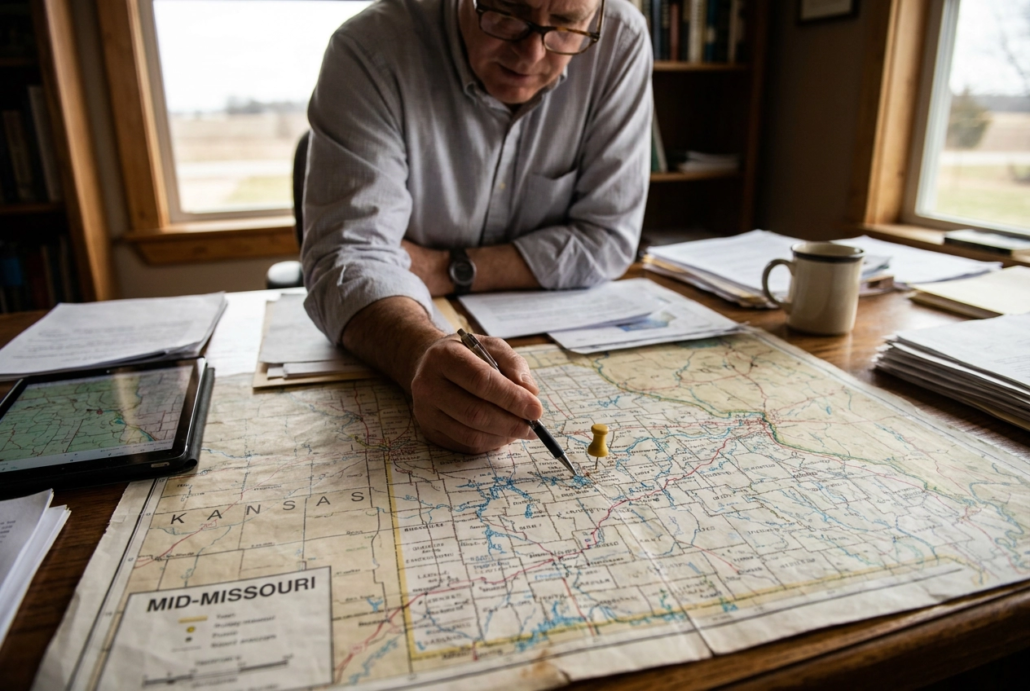
Eligible Section 502 Guaranteed loans are structured to minimize the down payment barrier, confirm current program terms on rd.usda.gov, and the rules hinge on one detail most buyers overlook: the property address.
This tutorial breaks down Mid Missouri USDA Home Loan Eligibility | Zero Down step by step. You will learn how USDA property eligibility works, which Mid-Missouri towns qualify, what changes across the Kansas state line, and how income limits vary by county and household size for FY 2026. You will see what zero down really means once the guarantee fee, closing costs, and seller concessions are counted, and how USDA payments compare to FHA, conventional, and VA on the same house.
From there, I will show you how to start your USDA pre-approval in Missouri or Kansas, how to check an address and save listings with the live MLS search, and the answers to the questions buyers ask most. Send me the property address and I will check it against the USDA map and confirm the county income limit before you write an offer. No credit pull to check.
How USDA Property Eligibility Actually Works in Mid-Missouri
The Short Answer
The USDA Section 502 Guaranteed program exists so approved lenders can finance moderate-income households buying a primary residence in an eligible rural area. In USDA terms, “rural” is everywhere except cities or towns with more than 50,000 inhabitants and the contiguous urbanized area attached to them. The regulatory basis for that definition is in 7 CFR Part 3555, confirm the current text there before citing a specific section.
Eligibility Is Address Driven, Not Zip Code Driven
You enter one specific street address into the USDA Single Family Housing eligibility tool, and the system matches it against the eligible-area map. Two houses a mile apart can land on opposite sides of the line, so a town name never settles the question. See Which Areas Near Columbia and Jefferson City Qualify for a USDA Loan? for the local picture.
The map is a screening tool, not a verdict. USDA states that final determination of property eligibility must be made by Rural Development upon receipt of a complete application. Anything you hear from a lender before that point is a pre-check. A pre-check is not approval, and I will say so plainly.
Two Terms That Decide Fringe Parcels
Contiguous urbanized area means the built-up sprawl connected to a 50,000-plus city, not the city limits sign itself. A Columbia or Jefferson City mailing address does not automatically make a parcel ineligible. City limits are often associated with the ineligible area, but confirm against the address tool rather than treating it as settled.
Move outside the urbanized footprint surrounding Columbia or Jefferson City and you may cross into eligible rural territory, the exact boundary follows the USDA map, not a mileage rule.
Which Mid-Missouri Towns Qualify for USDA Zero Down
The shortlist buyers ask about most: Ashland, Hallsville, Centralia, Holts Summit, Fulton, Boonville, California, Moberly, Eldon and much of the Lake of the Ozarks region. Treat it as a starting point, not a guarantee. Confirm each individual address in the USDA property eligibility tool before you write an offer.
Below are commonly asked-about addresses that buyers should check individually. Each town name is a starting point; fringe-parcel notes illustrate where boundaries are particularly fluid. No drive-time figure or eligibility status in this list should be treated as verified data.
- Ashland, Annexed edges shift; check any address near the town boundary.
- Hallsville, New edge subdivisions warrant individual address checks.
- Centralia, A county line runs through the area; parcels on either side need separate checks.
- Holts Summit, Annexation activity along US-54 makes fringe addresses unpredictable.
- Fulton, Edge plats change; confirm every address individually.
- Boonville, River bottom parcels can differ from in-town addresses.
- California, Rural fringe extends outward; unincorporated parcels especially need a check.
- Moberly, Industrial-edge addresses vary.
- Eldon, Lake-adjacent parcels vary; the shoreline is not the eligibility line.
- Lake of the Ozarks region, Eligibility depends on the exact parcel, not the shoreline or general area.
Each of these towns is below the threshold at which USDA automatically excludes a city, but population figures should be confirmed against current Census data, and the address tool is the only reliable test.
Boundary cases trip buyers up more than the town list: newly annexed land, subdivisions platted on the edge of a city, Columbia or Jefferson City mailing addresses on unincorporated county parcels, and lake-area homes where eligibility depends on the exact parcel, not the shoreline.
In Fulton, Moberly, Boonville and Eldon, USDA competes head to head with FHA on the same listings. The difference shows up in down payment and monthly mortgage insurance, not the interest rate. That comparison matters more than the headline rate. If the address falls outside USDA and the price tops the conforming limit, jumbo financing in Missouri and Kansas takes the file from there.
Send me the address and I will run the pre-check before you write an offer.
Kansas Towns and Counties: What Changes Across the State Line
The address-first logic does not stop at the state line. Kansas buyers run the same two tests; only some of the numbers change.
The Rural Test Is Federal. The Income Test Is Local.
USDA’s rural definition is set at the federal level, so it does not shift when you cross from Missouri into Kansas. The same federal rural definition applies in Kansas as in Missouri. Income limits do shift. USDA publishes limits by county or metro area, so an eligible address in one state can carry a very different household income cap than a similar address 20 miles away in the other (FY 2026 income limit table).
Kansas Geography to Think Through
The Kansas City metro straddles the state line. The Kansas City metro on the Kansas side includes large urban areas; run the address tool before assuming any specific county address qualifies. Outlying Kansas counties away from the metro core may carry eligible footprints, confirm each address in the USDA tool. None of that settles a specific parcel. The address check does.
One Pre-Approval, Both States
DreamLux Home Loans is licensed in Missouri and Kansas. A buyer relocating from Overland Park, Topeka or Wichita toward a Mid-Missouri town can be pre-approved once and shop both sides of the line without restarting the file. That continuity matters for complex files, including physician home loans in Missouri and Kansas, where income and student debt need careful structuring.
Costs Change at the Border
Property taxes, insurance requirements, title and closing practices, and appraisal expectations all change at the state line. Two houses at the same list price in two different states can produce different cash to close and different monthly payments. Compare both before you commit.
Two Tests, Then Three Things to Send
An eligible area is only half the answer. The address has to clear the rural determination, and your household income has to fall under the county limit for the year the loan is made. Send three items to the address-check workflow at the end of this page: the property address, the county, and the number of people who will live in the home. The FAQ covers the rest.

USDA Income Limits by County and Household Size for FY 2026
USDA builds every county’s cap from the same three-part formula. The moderate-income limit is the greatest of 115 percent of U.S. median family income, a state-based alternative tied to statewide and state non-metro median family incomes, or 115/80ths of the area’s low-income limit. Because the highest figure wins, and each figure comes from a different geography, neighboring counties can land at meaningfully different ceilings.
Limits also scale with household size. USDA publishes one limit for households of 1 to 4 persons and a higher limit for households of 5 to 8 persons in every county or metro area. Above eight people, add 8 percent of the 4-person limit per additional person. The same house can clear the cap easily for a family of four and fail for a single buyer with strong income.
Vintage matters. The applicable limits are FY 2026, and the USDA Single Family Housing Guaranteed Loan Program income limit table carries a footer dated 07-13-2026. USDA publishes limits by fiscal year, always confirm you are working from the current-year table before closing.
One transparency note: the version of the FY 2026 income limit document reviewed for this page showed Alabama tables before truncating. Missouri and Kansas figures come from the state sections of that document, so any county amount not yet pulled appears here as “confirm FY 2026 figure.”
Here is how the table reads, using Alabama as the format example only. Anniston-Oxford MSA: $122,800 for 1 to 4 persons and $162,100 for 5 to 8. Huntsville MSA: $132,850 for 1 to 4 and $175,400 for 5 to 8. These illustrate the layout, not Missouri or Kansas limits.
Income counting includes all adults in the household, not just the borrower, so confirm the total before assuming you are under the cap.
When the address misses the income test, an FHA mortgage loan has no rural address requirement and no income cap. Send the address and household size, and I will confirm the limit that applies.
What Zero Down Really Means: Guarantee Fee, Closing Costs and Seller Concessions
Income limits decide who qualifies. Zero down decides what you bring to closing, and those are two different numbers.
Zero down describes the down payment requirement, not cash at closing. An eligible Section 502 Guaranteed loan is structured for 100 percent financing of the purchase price, confirm current program terms on rd.usda.gov. Cash at closing is separate: closing costs, prepaid taxes and insurance, and any inspection or appraisal you order.
The guarantee fee. USDA backs the loan with a fee instead of mortgage insurance: an upfront fee lenders typically finance into the loan balance, and an annual fee paid monthly. Current percentages are not in the sources reviewed here, so confirm the upfront and annual amounts, and whether the annual fee applies to the original or declining balance, with USDA or your lender.
Cash-to-close strategies. Three levers keep money in your pocket: seller concessions written into the contract, lender-paid or reduced-cost structures through premium pricing, and documented gift funds where program rules allow. USDA caps seller or interested-party contributions at 6 percent of the sales price under HB-1-3555 Chapter 6; lender-paid closing costs and the upfront guarantee fee sit outside that cap. Confirm the cap that applies to your loan.
Why USDA often beats FHA on payment. FHA requires a minimum down payment plus both an upfront and an annual mortgage insurance premium. Hold price, taxes and insurance constant and the FHA payment is often higher month to month. When the address qualifies, USDA tends to win on cash and payment. Run both through the estimator below.
What zero down does not promise. It is not available to every buyer. Eligibility depends on the address clearing the rural determination, household income under the county limit for your household size, credit and income documentation, and the property passing USDA requirements, including the primary residence rule. Your lender’s pre-check narrows the field early; Rural Development makes the final call.
Why this matters before your offer. Knowing your down payment and closing cost picture in advance lets you write a cleaner contract with fewer financing contingencies and less risk of renegotiating after the appraisal. Send the address first. For more detail, review USDA loan questions.
USDA vs FHA vs Conventional vs VA: Payment Comparison on the Same House
To compare programs honestly, hold the purchase price, property taxes, homeowners insurance, credit profile and loan term constant. Change only the loan program. Anything else turns a payment comparison into a marketing exercise.
USDA: no required down payment on eligible addresses, confirm current terms on rd.usda.gov, and a guarantee fee instead of monthly MI. See the zero-down section for fee details.
FHA: low down payment, more forgiving credit and debt-to-income flexibility, no rural address requirement and no income cap. Mortgage insurance terms depend on loan-to-value and loan date, confirm the current duration rules with a HUD or lender source. This is often the fallback when an address does not qualify for USDA.
Conventional: higher down payment thresholds and stricter credit expectations, but mortgage insurance cancellation rules apply once sufficient equity is established, confirm thresholds with your lender, and lender-paid mortgage insurance options exist. A strong choice for buyers with reserves and documented income.
VA: for eligible service members, veterans and surviving spouses, no down payment and no monthly mortgage insurance, with a funding fee that some borrowers are exempt from. DreamLux Home Loans serves the VA community around Fort Leonard Wood, Whiteman Air Force Base and the Truman VA hospital in Columbia.
Run the same house through all four programs with the payment estimator on this page. Compare monthly payment and cash to close side by side, then shortlist the structure that fits your cash position and how long you plan to keep the home. A lower payment with more cash due at closing can fit you worse than a slightly higher payment you can start today. If you are comparing 30-year fixed pricing first, review Missouri 30-year fixed mortgage rates before you choose a program.
Rates and fees change. The estimator is a planning tool, not a locked quote.
How to Start Your USDA Pre-Approval in Missouri or Kansas

You have the four-program numbers. Now sequence the steps so a USDA pre-approval does not stall your offer.
Step 1: Send the address before you fall in love with the house. The address tells you whether USDA is even on the table for that parcel. Treat it as an address-only lender pre-check. It costs you a message, not a mortgage application. Ask how the pre-check treats credit before you authorize anything; confirm whether it is a soft inquiry or a hard pull, because that wording matters.
Step 2: Confirm the county income limit for your household size. Add up total household income for everyone who will live in the home. Compare that figure to the FY 2026 limit for the county or metro area. Do this early. If you are close to the ceiling, you want to know before the appraisal, not after.
Step 3: Assemble a file that matches your income type. W-2 buyers bring recent pay stubs and tax returns. Self-employed buyers, 1099 earners and business owners often qualify better with bank statement, profit-and-loss or asset-based documentation than with returns that understate real income. DreamLux Home Loans structures those files regularly.
Step 4: Run the four-program comparison before you write the offer. Know your maximum purchase price, your cash to close and the monthly payment you can comfortably carry. Shopping matters here. USDA pricing and underwriting guidelines vary between wholesale investors, so the same borrower can get different answers from different lenders.
Step 5: Plan for the USDA step itself. Rural Development makes the final property eligibility determination on a complete application. Expect your file to be submitted and confirmed later in the process. A pre-check narrows the field early. It does not replace that final call.
DreamLux Home Loans reports access to 280 or more lenders through its brokerage platform. That is how one pre-approval can be shopped across USDA, FHA, conventional and VA guidelines without starting over with each lender. Start Your Application to begin.
Check Your Address and Save Listings With the Live MLS Search
Your pre-approval tells you what you can borrow. Two tools tell you where that loan can actually close: the USDA address lookup and the live MLS search on this page.
The two-tool workflow
The workflow runs in one direction. Enter a specific property address in the USDA Single Family Housing eligibility tool first. That matches the parcel against the eligible-area map and answers the rural determination for that one address. Then open the live MLS search to see what is genuinely for sale in the towns that screen as eligible. The tool confirms a parcel; the MLS shows you inventory.
Saved searches that work
Set saved searches by town and price band, not by a three-county radius. A saved search for Fulton under $250,000 or Moberly under $225,000 sends listings you can act on. A broad radius across Boone, Callaway and Cole counties fills your inbox with houses that cannot close with USDA financing, including most in-town Columbia and Jefferson City addresses.
Filter by the towns covered in the eligibility section above, plus unincorporated parcels within commuting range. The eligible footprint can extend beyond a town’s incorporated limits, each unincorporated parcel still needs its own address check.
Pre-tour checklist
Before you spend a Saturday driving, run three checks:
- The address screens eligible in the USDA tool.
- Your household income fits the county limit for your household size.
- The property meets USDA basics, including use as your primary residence.
The address check is a quick web lookup in the USDA tool and does not require submitting a full mortgage application to get a preliminary answer. It also keeps your offer clean, because you are not writing contracts on parcels that will fail the rural test later.
While you are comparing towns, keep an eye on Missouri mortgage rates today so you know what a USDA quote should look like against the market.
Send the property address and we will confirm potential eligibility and the county income limit before you write an offer, then structure the loan around your cash position and timeline.
USDA Eligibility FAQs for Mid-Missouri and Kansas Buyers
The address check settles the biggest question first. These are the follow-ups Mid-Missouri and Kansas buyers ask next.
Does Columbia or Jefferson City qualify for a USDA loan?
Columbia and Jefferson City addresses often fall outside the eligible area because both cities exceed the population threshold, but only an address-level check in the USDA tool gives a definitive answer for any specific parcel. A Columbia or Jefferson City mailing address does not automatically disqualify an unincorporated parcel nearby.
Which Mid-Missouri towns are commonly inside the eligible area?
See the town-by-town section above; each address still needs its own USDA tool check.
How much income can I make and still qualify?
See the income limits section above; FY 2026 figures apply by county and household size, and total household income for all residents counts.
Do I really need zero dollars to buy?
See the zero down mechanics section for what you still bring to closing.
Can I use USDA on a second home or a rental?
No. Section 502 Guaranteed financing is for a primary residence. Second homes and investment properties need other programs, and DreamLux Home Loans can walk through conventional, jumbo and DSCR options for those.
What if my address does not qualify?
FHA, conventional, and VA loans are not restricted to rural addresses, confirm specific eligibility rules with your lender or the relevant program guidelines. The comparison table shows what each program costs on the same house, so the fallback path is clear.
Your Next Step: Send the Address, Get a Straight Answer
The FAQ answers above lead to one conclusion: in Mid-Missouri and across the Kansas line, zero down comes down to the address and your household income against the county limit, not the town’s reputation. Three moves turn that into a decision you can act on.
- Send the property address first. A lender pre-check confirms whether that parcel sits in an eligible rural area and what the FY 2026 income limit is for your county and household size. Do this before you tour, not after you fall in love with the house.
- Run the payment estimator on the same house. Compare USDA, FHA, conventional and VA with price, taxes and term held constant. You will see monthly payment and cash to close, not just an interest rate.
- Save two MLS searches in towns that qualify. Search by town and price band instead of a wide radius, so your alerts stay inside the eligible footprint. When the right listing appears, you can move the same day.
Expect a lender pre-check before your offer and a Rural Development final determination later in the process.
Send the address and we will confirm eligibility and the income limit for that county, then build the loan structure that fits your situation.
Zach Brown, NMLS #2156538, DreamLux Home Loans, a DBA of NEXA Lending, LLC, NMLS #1660690, Equal Housing Lender, licensed in Missouri and Kansas.
Conclusion
USDA zero down in Mid-Missouri is an address question, not a town reputation question. Eligibility follows the parcel, and your household income must land under the FY 2026 county limit for your family size. Kansas towns across the state line follow their own county rules, so the same house hunt can change with a zip code. That is why the payment comparison matters more than the rate alone. Send the address today. We will confirm eligibility, pull the correct income limit, and build a structure that fits. One address, one straight answer, and a clear path to keys. Let’s get started.








 Zach Brown | NMLS #2156538 | DreamLux Home Loans, a DBA of NEXA Lending, LLC | NMLS #1660690 | Equal Housing Lender | Licensed in Missouri & Kansas