Mortgage Pre-Approval in Missouri and Kansas: How to Get Approved, What Lenders Verify and How Long It Lasts
A mortgage pre-approval is the difference between hoping a seller takes you seriously and being able to prove you can close. In Missouri and Kansas, where the same house often draws several offers in the first weekend, the buyer holding a verified pre-approval is the one the listing agent calls back first. This guide explains what pre-approval is, how it differs from pre-qualification, what you need to supply, how long it lasts, and how to compare offers from more than one lender without hurting your credit.
What a Mortgage Pre-Approval Actually Is
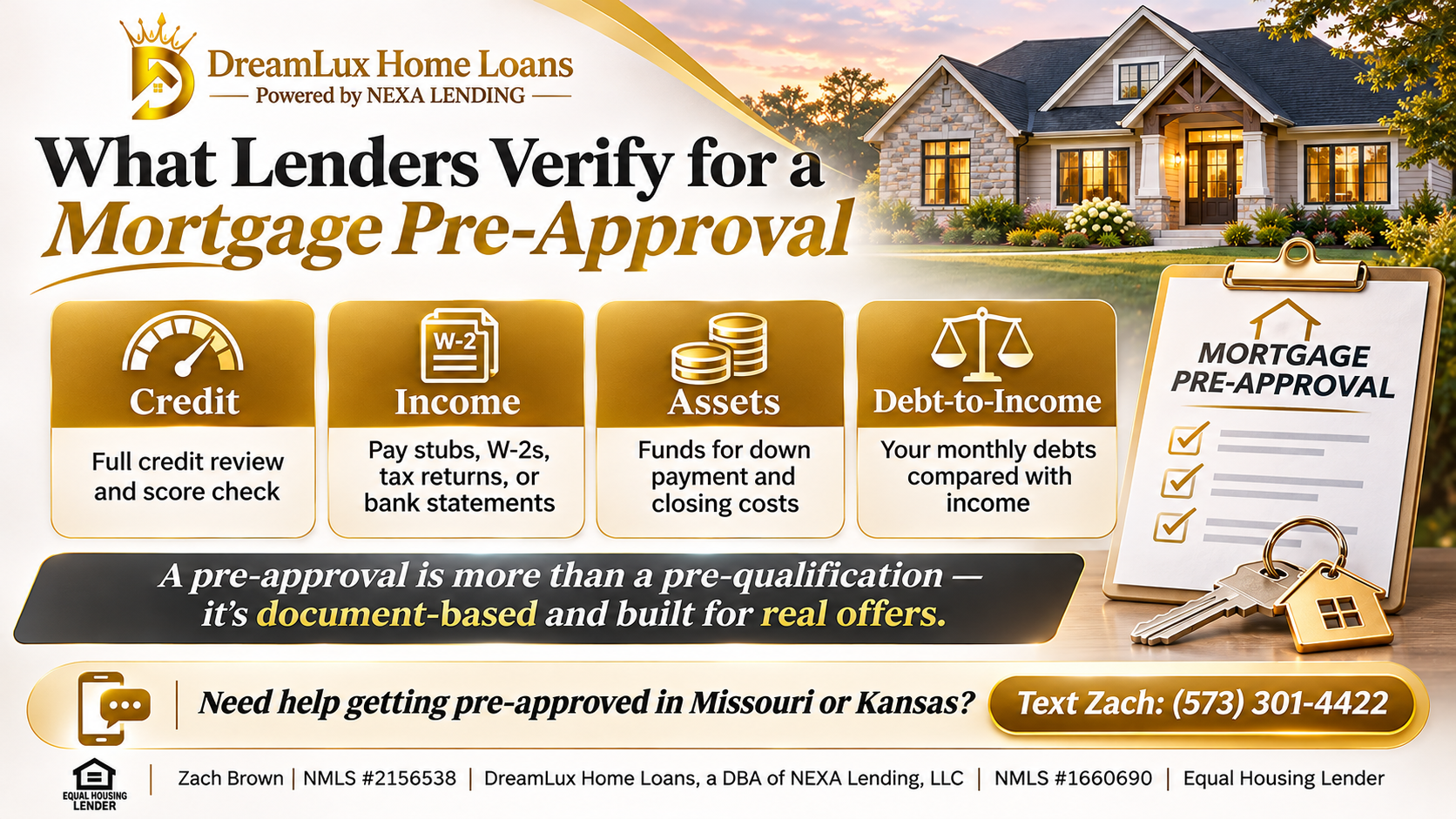
A pre-approval is a lender’s written decision, based on documents you have submitted, that you qualify for a specific loan amount under a specific program. It goes further than a pre-qualification, which is typically a quick estimate from stated income and a soft credit check.
A pre-approval generally involves:
A full credit pull and review of your credit report
Income verification through pay stubs, W-2s, tax returns or bank statements
Asset verification for down payment and closing costs
A check of your debt-to-income ratio against the specific loan program’s guidelines
That document is what you hand a real estate agent in Columbia, Kansas City, St. Louis or the Lake of the Ozarks when you make an offer.
Pre-Approval vs. Pre-Qualification: Why the Difference Matters
Pre-qualification answers “roughly what could I borrow?” Pre-approval answers “what will a lender commit to lend me, and on what terms?” Sellers and listing agents in Missouri and Kansas treat them very differently, and some sellers’ agents will not forward an offer to their client without a verified pre-approval letter attached.
Pre-qualification is useful for early planning. It is not a substitute for pre-approval once you are seriously touring homes.
How the Pre-Approval Process Works, Step by Step
Initial conversation. You talk through goals, timeline, credit picture and down payment. This is where the loan program gets chosen.
Document collection. Income, asset, identity and, where relevant, gift or business documentation.
Underwriting review. A pre-approval done properly is reviewed by underwriting, not just run through an automated engine.
Pre-approval letter issued. The letter states your maximum purchase price, loan amount, program and expiration.
If you want the complete document list laid out in one place, our mortgage pre-approval checklist walks through it item by item.
What You Need to Get Pre-Approved in Missouri or Kansas
Most borrowers should be ready to provide:
Government-issued ID and Social Security number
Last 30 days of pay stubs and two years of W-2s, or two years of tax returns if self-employed
Two months of bank and investment statements
Explanation of any large or unusual deposits
Rental income documentation if you own investment property
For VA loans, your Certificate of Eligibility; for FHA, nothing extra at this stage
Self-employed buyers, 1099 earners and business owners often qualify on more than tax returns alone. Bank statement and self-employed loan programs let deposits and profit-and-loss statements show real income that tax returns understate.
How Long Is a Mortgage Pre-Approval Good For?
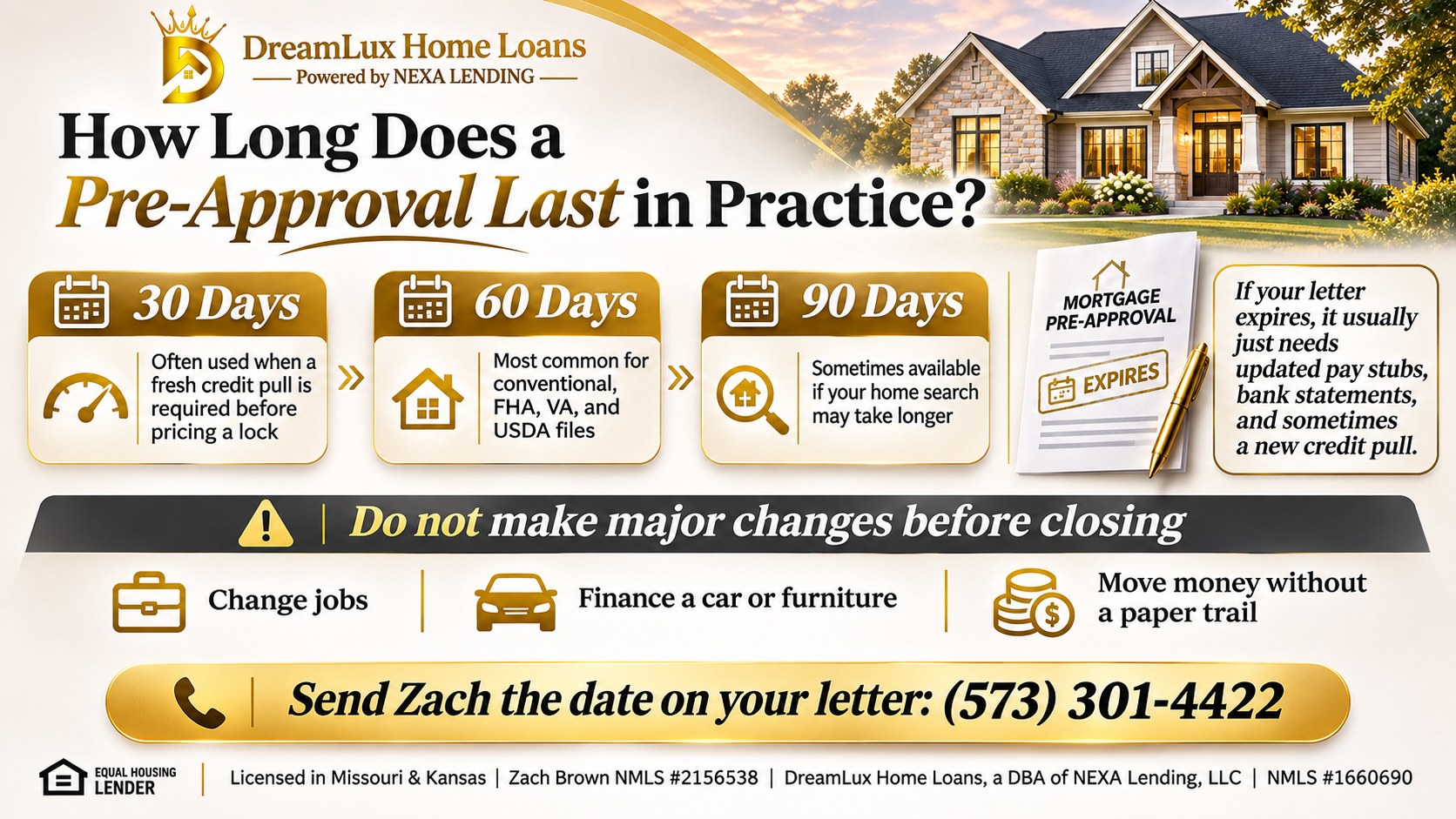
Most pre-approval letters in Missouri and Kansas are good for 30 to 90 days. Sixty days is the most common window; some lenders and credit unions issue 90-day letters, and a few investors shorten it to 30 so they can re-pull credit before they price a lock. The expiration date is printed on the letter itself, and it matters at offer time: a listing agent reading a letter that lapsed last week treats it as no financing at all.
How Long Does a Mortgage Pre-Approval Last in Practice?
30 days — common where the investor wants a fresh credit pull before pricing a lock.
60 days — the typical window for conventional, FHA, VA and USDA files.
90 days — usually a broker or credit union extension, and the one to ask for if your search may run past two months.
When a pre-approval is close to expiring, most lenders will re-issue it without a new application, provided your income, assets and credit still check out. Expect to send updated pay stubs and bank statements, and expect a second credit pull. A rate lock is a separate commitment with its own expiration and its own cost — never treat the pre-approval date as your lock date.
How Long Pre-Approval Takes to Issue
Turnaround depends on how fast documents arrive and how complex the file is. A straightforward W-2 borrower with complete paperwork is typically reviewed within a day or two; a self-employed borrower with multiple entities, rental properties or a jumbo loan takes longer because more documentation has to be read carefully.
Pre-approval letters usually carry an expiration, commonly somewhere between 30 and 90 days, and most lenders will refresh one with updated pay stubs and statements. If your rate lock matters to you, ask about the difference between a pre-approval letter and a locked rate — they are not the same commitment.
What Pre-Approval Does and Does Not Lock In
A pre-approval is a statement of creditworthiness, not a rate lock and not a guarantee. It can change if your financial picture changes before closing: a new car loan, a financed furniture purchase or a job change can alter the file. Once you are under contract, the loan still has to go through final underwriting on the specific property, including appraisal. Treat the pre-approval amount as a ceiling, not a target — buying below it usually means a more comfortable payment.
How to Compare Pre-Approval Offers From Multiple Lenders
This is where most buyers leave money on the table. Two lenders can approve you for the same loan amount at meaningfully different pricing, fees and program overlays. Compare, at minimum:
Interest rate and any points quoted
All lender fees, itemized on a Loan Estimate
Whether the pre-approval was underwritten or automated
Program fit: FHA, VA, USDA, conventional, jumbo or a specialty program
A broker works in the opposite direction from a single retail bank: instead of one rate sheet, one file is shopped across many wholesale lenders. DreamLux Home Loans works with access to 280+ lenders, which is the practical reason shopping a file matters. If you want the mechanics of that comparison, read mortgage broker vs. bank and our guide to conventional purchase financing in Missouri and Kansas.
Pre-Approval for Different Borrower Types
Program choice is decided at pre-approval, and the right program changes everything:
FHA — lower credit and down payment thresholds, with mortgage insurance. See FHA mortgage loans.
VA — no down payment for eligible service members, veterans and surviving spouses, including buyers near Fort Leonard Wood, Whiteman Air Force Base and the Truman VA community in Columbia.
USDA — rural Missouri and Kansas properties, including many towns outside the metro corridors. See USDA loans.
Physician loans — student debt treated differently and no PMI, for residents, fellows and attending physicians. See physician mortgage loans.
Jumbo — above the conforming limit, common around the Lake of the Ozarks and higher-priced Kansas City suburbs.
DSCR and investment property — qualification on rental income rather than your personal return.
Down payment assistance is also worth checking before you finalise a pre-approval, because it can change how much cash you need. Our down payment assistance page covers Missouri programs.
Frequently Asked Questions
How long is a mortgage pre-approval good for? Typically 30 to 90 days, with 60 days the most common in Missouri and Kansas. The expiration date is on the letter, and a lender can usually refresh it with updated documents before it lapses.
How long does a mortgage pre-approval last if I have not found a house yet? It still expires on the date printed on the letter. If your search is likely to run longer than two months, ask for a 90-day letter, and plan on a short refresh — new pay stubs, new statements and a second credit pull.
Does pre-approval hurt my credit score? A mortgage credit inquiry has a small effect, and multiple mortgage inquiries within a short window are generally treated as a single shopping event.
Can I get pre-approved before I have found a house? Yes, and you should. Pre-approval before touring keeps you from falling for a home you cannot finance.
Is pre-approval the same as approval? No. Final approval happens after underwriting reviews the specific property, the appraisal and the completed file.
Do I need pre-approval to make an offer in Missouri or Kansas? You do not strictly need it, but many sellers’ agents will not present an offer without it, and sellers routinely choose the offer with the strongest financing.
Ready to Get Pre-Approved?
DreamLux Home Loans is a licensed mortgage brokerage serving Missouri and Kansas, led by Senior Mortgage Loan Officer Zach Brown (NMLS #2156538). Whether you are buying in Columbia, Ashland, Jefferson City, Kansas City, St. Louis or at the Lake of the Ozarks, the first step is a pre-approval you can actually use — one that has been reviewed, priced across multiple lenders and matched to the right program for your situation. Start with the pre-approval checklist, then let us put your file in front of the lenders that fit it.
DreamLux Home Loans Welcomes: Scott Wilson, Senior Mortgage Loan Officer, on Veterans Day 🇺🇸
November 11, 2026 | Columbia, Missouri
DreamLux Home Loans welcomes Scott Wilson (NMLS #2181239) alongside Zach Brown (NMLS #2156538), while honoring veterans and their service on November 11, 2026
DreamLux Home Loans is pleased to announcethatScott Wilson, Senior Mortgage Loan Officer (NMLS #2181239), has joined our Missouri mortgage lending team:
Scott brings valuable mortgage lending knowledge, strong attention to detail, and a commitment to helping homebuyers and homeowners understand their financing options.
The announcement comes on Veterans Day, making this an especially meaningful occasion to recognize Scott’s military service and thank the men and women who have served our nation 🇺🇸 🎖️
Expanding Our Missouri Mortgage Team:
DreamLux Home Loans is a mortgage brokerage operating under NEXA Lending, LLC (NMLS #1660690)
Our team helps borrowers explore home purchase, refinance, and investment property financing through access to 280+ wholesale lenders.
With Scott joining the team, Missouri borrowers have another experienced mortgage professional available to discuss their goals, understand their options, and receive personalized guidance through the lending process.
“I’m genuinely excited to welcome Scott to the DreamLux Home Loans Team. He’s going to be a major asset to not only our team, but also bring his attention to detail, professionalism, and dedication to all the wonderful people we help serve here in Missouri, Kansas & beyond where we expand out to. Scott has the exact qualities that I value in building our mortgage team to fully go the extra mile in helping people” — Zach Brown
Zach serves borrowers throughout both Missouri and Kansas, including Columbia, Jefferson City, Kansas City, St. Louis, the Lake of the Ozarks, and surrounding communities.
Honoring All Veteran Heroes Today 🇺🇸
At DreamLux Home Loans, we’re grateful to recognize Scott’s military service on Veterans Day.
We also extend our sincere appreciation to every veteran hero, active-duty service member, and military family for their time, service, sacrifice, bravery, and commitment.
Thank you for all your service and everything you’ve given to us in our country.
Connect with DreamLux Home Loans Today!
Are you preparing to purchase a home, refinance an existing mortgage, or explore available loan programs?
Click Here to Visit DreamLux Home Loans Website to connect with Zach & Scott, review available mortgage services, or begin the application process. We look forward to helping you take your next steps with greater clarity & confidence.
Ready to Explore Your Mortgage Options?
Connect directly here (in our link below) with our DreamLux Home Loans team to compare the best tailored financing options for your next home purchase, investment property or refinance.
Short answer: A physician mortgage loan lets a resident, fellow or attending physician buy a primary home in Missouri or Kansas with little or no down payment and no monthly mortgage insurance, and it qualifies you on a signed employment contract instead of waiting for the first paycheck. Each lender writes its own version, so the student loan rule, the financing cap and the credit floor change from one to the next. I broker physician loans across 280+ wholesale lenders for doctors landing at MU Health Care, KU Medical Center, Children’s Mercy, Saint Luke’s, WashU and BJC, SLU, Mercy and the other training hospitals across both states. Send me your contract and your match location, and I will show you which program fits before you tour a single house.
Match Day is in March. Most contracts start July 1. That gap is when physician home loans get used, and this guide covers what you need to know inside it: what a physician loan is, who qualifies, how residents buy before the paycheck arrives, how attendings and 1099 physicians are underwritten, how the programs compare to conventional and jumbo, which Missouri and Kansas hospitals and medical schools I see buyers coming from, what documents to gather, what no PMI and zero down really mean, how to compare Loan Estimates, and the myths that cost doctors money.
What Is a Physician Mortgage Loan?
A physician mortgage loan is a mortgage program offered by select lenders that relaxes standard underwriting for licensed physicians and certain other medical professionals. It commonly features down payments from 0% to 10% depending on loan size, no monthly private mortgage insurance, and the ability to qualify on a signed contract before you start.
Physician loans belong to the broader family of professional loan programs, which at many lenders also cover dentists, oral surgeons, podiatrists, optometrists, veterinarians, pharmacists and CRNAs. Each lender writes its own guidelines, so terms are not standardized the way FHA or VA loans are.
Structurally, most physician loans are conventional or jumbo loans with lender-specific overlays, often held in the lender’s own portfolio. Loan size determines whether the file lands in conforming or jumbo territory. Conforming limits are set each year by the FHFA, and many physician purchases in west St. Louis County, Johnson County and the Lake of the Ozarks run past them.
A physician loan is not a government-insured loan, and it is not a state down payment assistance program. It is a private product, which is exactly why the lender you pick matters more than it does on an FHA or VA file. The Missouri and Kansas physician home loans page covers the product in detail. This article covers how to use it.
Who Qualifies? Residents, Fellows and Attending Physicians
Most programs target MDs and DOs in residency, fellowship or practice. Many extend to dentists, oral surgeons, podiatrists, optometrists, veterinarians and CRNAs. Each lender publishes its own eligible-profession list, so confirm yours before you shop.
Employment stage often outweighs current income. A resident or fellow can be approved on a signed employment contract that documents the future salary, even before the first full paycheck arrives. Most programs want the start date within 60 to 90 days of closing.
Credit expectations are set lender by lender. Most physician programs want a 700 or better. A few go to 680. The strongest pricing goes to borrowers with higher scores and clean histories, and a single late student loan payment in training can cost real money here, so check your report before you apply.
Student loan treatment is the biggest variable. Some lenders exclude deferred or income-driven student debt entirely during training. Others count the actual IDR payment. Others count 1% of the balance or fully amortize it. On $250,000 of medical school debt, that one guideline can swing your buying power by well over $100,000. It is the first question I ask any lender before I send a physician file.
Residents and Fellows: Buying Before the Paycheck Arrives
Timing is the whole advantage. A physician loan qualifies you on the post-training salary in a signed contract, not on your current stipend, so a resident or fellow can be approved years before a standard lender would say yes.
Typical features include 100% financing up to a lender-set cap, commonly $750,000 to $1 million, with larger loans available at 5% to 10% down, no monthly mortgage insurance, and no requirement that you have owned a home before.
Here is the calendar that matters. Match Day falls in mid-March. Contracts arrive in the weeks after. Residency starts July 1. If you want to be in a house instead of a short-term rental on day one, pre-approval needs to happen in March or April, the offer in April or May, and closing in June. Start the conversation the week you match.
Watch employer-distance rules. Some lenders require the property to sit within a set radius of the hospital or practice, which affects a Columbia resident looking at Ashland or a KU resident looking at Lawrence.
Gift funds and, at some lenders, a small seller credit can be layered in when you prefer to keep cash for relocation, licensing fees and board exam costs.
Attending Physicians and Contract Income
The underwriting picture changes once training ends. W-2 attending physicians typically qualify on documented base salary. Many lenders also count contract income, relocation stipends and signing bonuses when the written agreement guarantees the amount and start date. Fannie Mae’s guidance on bonus and commission income sets the conventional baseline, though each lender’s overlay governs its physician program.
1099, locum tenens and private practice income works differently. When tax returns understate real earnings, bank statement and self-employed programs often fit better than a traditional physician loan. I compare both paths side by side during pre-approval.
Loan size shifts the program. Attendings buying in the Lake of the Ozarks or west St. Louis County often cross the conforming limit, where a physician jumbo replaces a standard physician loan and jumbo mortgages in Missouri and Kansas get priced very differently by each wholesale investor.
Part-time, prorated and job-share schedules are lender-specific. Some count 0.6 FTE income in full, others haircut it. Bonuses and stipends are typically averaged over two years unless a written contract guarantees the amount.
Dentists, Veterinarians and Other Eligible Professionals
Beyond physicians, many programs extend to dentists, oral surgeons, podiatrists, optometrists, veterinarians and CRNAs. The eligible-profession list is lender-specific and can change without notice, so never assume your license qualifies.
Documentation is similar across professions: an active license or license eligibility, a signed contract or offer letter, and proof of the professional degree. Practice owners may need extra business income paperwork.
Terms can differ by tier. Loan caps and down payment requirements for non-physician professionals are often less generous than the physician tier inside the same lender’s program. A dentist might see a lower financing cap or a higher minimum down payment than an MD. Before paying for an appraisal, I get each lender’s written eligible-profession list in hand.
Where Missouri and Kansas Physicians Train and Buy
Physician loans follow the contract, and in Missouri and Kansas the contracts cluster around a short list of institutions. If you matched or signed at one of these, the towns listed next to it are where I write most of the physician loans for that hospital. Every address still gets run against the lender’s distance rule.
Mid-Missouri
University of Missouri School of Medicine and MU Health Care, Columbia. The largest academic medical center between St. Louis and Kansas City, with residencies and fellowships across University Hospital, Women’s and Children’s Hospital, the Missouri Orthopaedic Institute, Ellis Fischel Cancer Center and the Truman VA. Residents buy in south Columbia (Thornbrook, the Rock Bridge corridor), Ashland and Hallsville. Attendings add Old Southwest, Thornbrook and acreage toward Rocheport. The Columbia physician home loans page covers this market street by street.
Capital Region Medical Center and SSM Health St. Mary’s Hospital, Jefferson City. Community hospitals that recruit heavily from MU and from out of state. Physicians buy in Jefferson City’s west side, Holts Summit, Wardsville and Taos, where commutes stay short and lot sizes grow.
Lake Regional Health System, Osage Beach. The Lake’s hospital recruits hospitalists, surgeons and specialists on relocation packages. Most of those buyers cross the conforming limit on a lakefront primary residence, which is a physician jumbo conversation, not a standard physician loan.
Kansas City Metro
The University of Kansas Medical Center and The University of Kansas Health System, Kansas City, Kansas. The region’s academic anchor, with the largest GME roster in Kansas. Residents buy in Roeland Park, Prairie Village, Mission and Westwood on the Kansas side, or Brookside and Waldo across the line. Attendings add Leawood, Overland Park and Fairway, and most of those purchases land in Johnson County jumbo territory.
Children’s Mercy Kansas City. Pediatric residencies and more than 40 fellowships on Hospital Hill. Pediatric trainees are the buyers most helped by the student loan exclusion, and they buy in Brookside, Waldo, Prairie Village and Lee’s Summit.
Saint Luke’s Health System, Kansas City. Residencies and fellowships at Saint Luke’s Hospital on the Plaza plus Saint Luke’s East in Lee’s Summit and Saint Luke’s North in the Northland. Buyers split between Brookside and the Plaza, Lee’s Summit and Blue Springs, and Liberty and Parkville.
UMKC School of Medicine and University Health, Kansas City. The six-year BA/MD program and the residencies at University Health (the former Truman Medical Center). Residents here are younger on average, often buying a first home in Waldo, the Northland or Raytown with a signed PGY-1 contract.
Kansas City University College of Osteopathic Medicine, Kansas City and Joplin. One of the largest DO programs in the country, with campuses in Kansas City and Joplin. DO graduates qualify for the same physician programs as MDs. Joplin buyers often land in Webb City, Carl Junction and the Joplin west side, and a surprising number qualify for USDA zero-down on the right address.
St. Louis Metro
Washington University School of Medicine and BJC HealthCare, St. Louis. Barnes-Jewish and St. Louis Children’s host one of the largest residency and fellowship consortia in the country. Residents buy in the Central West End, Dogtown, Maplewood, Richmond Heights and Kirkwood. Attendings add Clayton, Ladue and Town and Country, where St. Louis jumbo pricing decides the file.
Mercy Hospital St. Louis, Creve Coeur. Family medicine, internal medicine, OB-GYN and more at Mercy’s flagship. Buyers concentrate in Creve Coeur, Chesterfield, Ballwin, Wildwood and across the river in St. Charles County, where part of the county is still USDA-eligible for a resident on a tighter budget.
If your program is not on this list, send me the contract anyway. The lender does not care which hospital it is. The lender cares that it is signed.
Physician Loans vs Conventional and Jumbo Loans
Feature
Physician
Conventional
Jumbo
FHA
Minimum down payment
0% to 10%, by loan size
3% to 5%
10% to 20%
3.5%
Mortgage insurance
None
PMI under 20% down
Usually none
Upfront plus annual MIP
Student loans
Lender-specific, often excluded in training
Counted per agency rules
Counted
Counted
Income documents
Signed contract can suffice
W-2s, pay stubs
Full documentation
Full documentation
Loan limits
Lender caps
Conforming limit
Above conforming
County limits
Typical credit floor
700, some at 680
620
700 and up
580
Conventional financing starts at 3% to 5% down with PMI below 20% equity. Above the conforming limit, standard jumbo lenders typically want 10% to 20% down plus reserves. Physician jumbo programs may allow 5% to 10% down in St. Louis County, Johnson County and the Lake. FHA is not a physician program, though it fits some lower-credit scenarios.
The trade-off: a no-PMI physician loan at a slightly higher rate can cost more over five to seven years than conventional financing whose insurance drops off at 20% equity, especially for an attending with a real down payment. The only way to know is a side-by-side Loan Estimate, which is what I run on every physician file.
Why Lender Guidelines Differ and Why Shopping Your File Matters
Physician loans are overlay or portfolio products, not standardized ones. Each investor sets its own down payment, loan cap, reserve and student debt rules, so two lenders can approve the same borrower at very different terms. One lender may cap 100% financing at $750,000. Another may allow $1.5 million at 10% down. One may ignore IDR student loans. Another may count 1% of the balance. These are illustrations, not promises, and they change.
Pricing shifts with the delivery channel. A lender holding the loan in portfolio prices risk differently than one selling to an aggregator. That is why physician loan pricing rarely shows up on public rate tables, and why a broker with access to the programs that exist, rather than the one program a bank happens to offer, changes the outcome.
I compare physician programs across 280+ wholesale lenders through NEXA Lending. Not every lender offers one, so availability is confirmed during pre-approval. No broker can promise a rate or an approval. Terms depend on lender guidelines, credit, property and timing.
Do Missouri or Kansas Down Payment Programs Help Physicians?
Usually not, and it is better to know that up front. Missouri’s MHDC programs and Kansas Housing Resources Corporation programs carry household income limits that most attendings exceed and purchase price caps that many physician purchases exceed. A resident on a PGY-1 salary can sometimes fit, but most first mortgage programs will not allow a down payment assistance second lien behind them, and a physician loan already solves the down payment problem.
Where state and federal programs do matter for physicians: USDA zero-down for a resident taking a rural or small-town position, and VA financing for military physicians at Fort Leonard Wood, Whiteman Air Force Base and the Truman VA. Both are separate products from physician loans. I run them side by side when they apply.
Documentation You Will Need to Get a Physician Loan
Collect these before credit or the appraisal is ordered. Missing paperwork is the most common cause of a delayed pre-approval.
Government-issued photo ID and a signed borrower authorization.
Proof of an active or unrestricted medical license, or written license eligibility, plus proof of degree.
The signed employment contract or offer letter stating start date, salary and any signing bonus or stipend.
Pay stubs for the most recent 30 days if you are already working, and W-2s or 1099s for the past two years.
For practice owners and 1099 physicians, business and personal tax returns with all schedules and a year-to-date profit and loss.
A statement for every student loan showing balance, repayment plan and deferment or forbearance status. This is the document that decides approval more than any other.
Bank statements for down payment and reserves, signed gift letters if family is helping.
Some lenders accept the executed contract in place of pay stubs for early-career physicians. Others do not. I confirm the requirements before you collect anything. The document checklist has the full list.
What No PMI and 0% Down Really Mean
No PMI means no monthly private mortgage insurance, not freedom from risk-based pricing. A lender can offset the missing insurance with a slightly higher rate or a one-time fee. Zero down usually carries a financing cap. Exceed it and you bring cash to closing or the lender steps down to 95% or 90%.
Occupancy is the hard line. 100% physician loans are built for owner-occupied primary residences. Investment properties and second homes run on different programs.
Compare APR and total monthly payment, not rate alone. A no-PMI loan at a higher rate can cost more over the life of the loan than conventional financing with insurance that falls off at 20% equity.
Ask every lender four questions: Is any mortgage insurance required? Is lender-paid coverage built into the rate? How will escrow be set up? Does the financing cap change by county? Two loans with the same headline rate can carry very different total costs.
How to Compare Loan Estimates From Multiple Lenders
Request a full Loan Estimate from at least two lenders on the same day, using identical inputs: loan amount, term, down payment and property type. Vary one variable and the comparison stops being apples to apples.
Read each document section by section. Section A is origination charges. Section B is services you cannot shop for. Section C is services you can shop for. The fee differences hide in total closing costs, not the rate.
Then go to the Comparisons section: APR, total interest percentage and the five-year cost. Those capture the rate-versus-fee trade-off better than the headline rate.
Finally, weigh lock and float. Ask how long the lock runs, what a float-down costs if rates improve, and who absorbs the cost if closing slips past expiration.
Conventional. The benchmark every physician loan should be measured against, especially for attendings with 10% to 20% down.
Jumbo. Above the conforming limit in Columbia, the Lake, Johnson County and St. Louis County, wholesale investors price the same file very differently. Shopping matters most here.
Bank statement and self-employed. For 1099 attendings, locums physicians and practice owners whose returns understate real income.
VA. For military physicians and veterans, including VA jumbo above the conforming limit.
USDA and FHA. For specific addresses and credit profiles.
DSCR. For physicians buying rental property in Missouri or Kansas, qualified on the rent, not your W-2.
Refinance later. Once you are an attending with equity, a rate-and-term refinance out of a physician loan into conventional with no PMI is a common second move.
Common Myths About Physician Loans
Myth: You must already be an attending. Most lenders approve residents and fellows on a signed contract. Ask before assuming you cannot qualify.
Myth: No PMI means no added cost. Risk-based pricing, a higher note rate or a one-time fee often replaces it. Compare APR and total cost.
Myth: A physician loan always beats conventional. With a real down payment, conventional sometimes wins, and it always wins once PMI drops at 20% equity.
Myth: Student debt disqualifies physicians. Treatment ranges from excluding deferred and IDR debt entirely to fully amortizing it. This single guideline drives outcomes more than any other. Confirm each lender’s treatment before comparing offers.
Myth: DOs, dentists and vets are excluded. Most programs include them, often on a slightly different tier. Get the written eligible-profession list.
Frequently Asked Questions
Do physician loans require PMI? No. Most physician programs carry no monthly mortgage insurance. Lenders offset that through pricing, so compare APR, not just the absence of insurance.
Can a resident get a mortgage before the first paycheck? Yes, when a signed employment contract documents the salary and start date, along with license verification and acceptable credit. Most lenders want the start date within 60 to 90 days of closing.
What credit score do I need for a physician loan? Most programs want 700 or better. A few go to 680. Higher scores get better pricing.
How much can I borrow with a physician loan? Lender caps for 100% financing commonly run $750,000 to $1 million. Larger loans move to 5% to 10% down and into physician jumbo programs, often up to $1.5 million or more.
Can I use a physician loan for a second home or rental? Generally no. These programs are built for owner-occupied primary residences. Second-home and DSCR programs cover the rest.
How are student loans counted? It depends on the lender. Some exclude deferred and income-driven loans during training, some count the actual IDR payment, some count 1% of the balance. I match the file to the lender whose rule fits your balance.
I matched at MU, KU, WashU or Children’s Mercy. When should I start? The week you match. Pre-approval in March or April, offer in April or May, close in June, keys before July 1.
Are physician loans available in Missouri and Kansas? Yes. I am licensed in both states and compare physician programs for buyers in Columbia, Jefferson City, the Lake of the Ozarks, Kansas City, St. Louis, Springfield, Wichita and everywhere in between. Availability varies by lender and is confirmed during pre-approval.
Your Next Steps to a Physician Mortgage
Start the week you match or sign. Pull every student loan statement first and confirm the repayment plan, status and balance on each one, because that detail changes your borrowing power more than any other. Then send me the contract. I will get the written guideline summary from each lender that fits, covering the financing cap, the reserve requirement, the student loan rule and whether any mortgage insurance applies, and run the Loan Estimates side by side on the same day with the same inputs.
About the author. Zach Brown is a Senior Mortgage Loan Officer and the founder of DreamLux Home Loans in Columbia, Missouri, licensed in Missouri and Kansas (NMLS #2156538). Before mortgages he spent about a decade in exercise physiology and sports nutrition, which is why the first thing he reads on a physician file is not the salary line. It is the student loan statement, the same way he used to read a client’s food log before the scale. Read his client reviews.
This article is general information, not a commitment to lend or an offer of credit. Physician loan programs are lender-specific and change without notice. All loans are subject to credit approval, property approval and program guidelines. Hospital and medical school links are provided for reference and do not imply any affiliation or endorsement.
Zach Brown | NMLS #2156538 | DreamLux Home Loans, a DBA of NEXA Lending, LLC | NMLS #1660690 | Equal Housing Lender | Licensed in Missouri & Kansas
Conventional loans can offer flexible down payment options for eligible buyers. VA loans provide valuable benefits for qualifying veterans, service members, and surviving spouses. Jumbo mortgages generally finance loan amounts exceeding conforming limits and often have lender-specific requirements.
The right choice depends on your financial qualifications, the property, the available loan terms, and your plans for homeownership.
At DreamLux Home Loans, I help buyers compare financing across a network of 280+ wholesale lending partners rather than limiting the conversation to one bank’s products.
Depends on program; many jumbo products don’t require traditional PMI
2026 one-unit limit
$832,750 for conforming loans in MO & KS
No VA-imposed limit with full entitlement
Typically above $832,750 in MO & KS
Occupancy
Eligible primary, second-home, and investment uses
Generally primary residence
Eligible uses vary by lender
Major consideration
Loan-level pricing and mortgage insurance
Entitlement, funding fee, and VA eligibility
Down payment, reserves, credit, and property guidelines
These are broad comparisons, not guaranteed offers. Jumbo loans are generally a type of nonconforming conventional financing, while individual jumbo and VA lender requirements can vary significantly.
Not every Conventional mortgage requires 20% down.
Certain eligible programs allow down payments as low as 3%, depending on borrower qualifications, occupancy, income limits where applicable, and program requirements.
However, a smaller down payment may mean a higher loan amount, mortgage insurance, and different overall costs.
For example, a buyer considering a $350,000 home might compare:
3% down: $10,500
5% down: $17,500
10% down: $35,000
20% down: $70,000
Each down payment produces a different starting loan amount and may change the available rate, mortgage insurance, cash to close, and monthly payment.
The goal isn’t automatically to make the smallest or largest down payment. It’s to find a suitable balance between available cash, reserves, monthly payment, and financing costs.
VA-backed home loans are designed to help eligible veterans, military service members, and qualifying surviving spouses purchase qualifying homes.
VA financing is particularly valuable because eligible borrowers may be able to purchase with no down payment and without monthly private mortgage insurance.
Borrowers with full VA entitlement are not subject to a maximum VA-imposed loan limit.
However, the lender must still determine that the borrower qualifies for the requested mortgage amount, and the property must satisfy applicable appraisal and program requirements.
Borrowers with remaining partial entitlement may face different down-payment considerations.
It’s also important to understand the VA funding fee, which applies to many VA loans unless the borrower qualifies for an exemption.
The funding fee depends on factors including loan type, first or subsequent use, and down payment.
VA borrowers should compare their estimated funding fee, closing costs, available lender credits, and monthly payment against other qualifying mortgage options.
A VA-eligible buyer with significant funds available for a down payment may want to compare VA financing and Conventional financing on the same purchase scenario.
The most suitable option depends on the borrower’s eligibility, funding-fee status, available pricing, down payment, and long-term goals.
Some lenders offer lower-down-payment Jumbo programs for highly qualified borrowers, while others require larger down payments, stronger reserves, or different credit and income documentation.
Available requirements can vary based on:
Loan amount
Credit profile
Debt-to-income ratio
Available assets and post-closing reserves
Property type and occupancy
Fixed or adjustable-rate structure
Documentation and income type
There is no single universal Jumbo guideline that applies to every lender.
Jumbo financing can differ substantially across private and portfolio lending programs.
The same borrower and property may fit the requirements of one lender while falling outside another lender’s guidelines.
For higher-value properties, it can be useful to compare available financing structures before choosing a lender or committing to a down payment amount.
This is particularly relevant for buyers considering custom homes, luxury properties, higher-priced second homes, or properties with nonstandard financing characteristics.
Purchase price: $925,000 Down payment: $46,250 Starting mortgage amount: $878,750
The requested financing exceeds the 2026 conforming limit for a one-unit property in Missouri and Kansas.
A buyer may need to compare Jumbo financing, a larger down payment, or another eligible financing structure.
Scenario C: $900,000 Home With VA Eligibility
An eligible borrower with full VA entitlement may be able to finance a qualifying $900,000 primary-residence purchase using VA financing without a required down payment.
However, eligibility, affordability, lender approval, appraisal, and closing-cost requirements still apply.
The takeaway: Similar purchase prices can lead to entirely different financing options depending on borrower eligibility and loan structure.
These scenarios are simplified illustrations, not loan offers or approval representations.
Where you’re buying matters, even when federal loan guidelines are consistent.
Property types, insurance costs, property taxes, homeowners associations, available housing inventory, and lender requirements can influence the financing strategy.
Mid-Missouri buyers may be comparing a first home, a move-up purchase, a newly built property, or a custom home.
Conventional down payment options, VA eligibility, closing costs, and available funds after closing are all worth reviewing before establishing a purchase budget.
Buyers in Kansas City, Lee’s Summit, Blue Springs, Liberty, Overland Park, Olathe, Lenexa, Leawood, and Johnson County should consider both available loan programs and property-specific costs.
For higher-priced homes, compare the amount financed against the conforming loan limit rather than assuming a Jumbo loan is mandatory.
Buyers throughout St. Louis, Chesterfield, Kirkwood, Clayton, St. Charles, and nearby communities may benefit from comparing different combinations of mortgage rate, down payment, closing costs, and cash reserves.
Higher purchase prices alone do not determine the loan program.
DreamLux Home Loans also serves buyers in communities throughout both states, including Springfield, Branson, Lawrence, Topeka, Manhattan, and Wichita.
Specific program availability and approval depend on the borrower, property, and participating lender.
Not always. VA financing offers important benefits for eligible borrowers, including potential zero-down-payment financing and no monthly mortgage insurance. But the VA funding fee, available down payment, lender pricing, and borrower goals should be considered before making a decision.
Yes. Certain Conventional mortgage programs allow qualifying buyers to purchase with as little as 3% down, subject to applicable eligibility requirements.
For a one-unit property, the 2026 baseline conforming loan limit is $832,750. A non-government-backed mortgage above the applicable conforming limit is generally considered Jumbo or nonconforming financing.
Not necessarily. A $900,000 home purchased with $90,000 down produces an $810,000 starting loan amount, below the 2026 one-unit conforming limit in Missouri and Kansas.
Potentially, yes. Borrowers with full VA entitlement have no VA-imposed loan limit, but lender approval, income, credit, affordability, and appraisal requirements still apply.
Yes. An initial financing conversation can help you understand possible purchase budgets, down payment strategies, available programs, and the steps toward pre-approval. Formal loan terms and approval depend on the complete borrower and property information.
You don’t need to know whether Conventional, VA, or Jumbo financing is right for you before reaching out.
That’s what the mortgage comparison process is for.
Whether you’re buying your first home, relocating, considering a luxury property, or simply looking for a second opinion, I’d be happy to help you understand your available options.
Company NMLS Company NMLS #1660690 | Equal Housing Lender |
Important disclosures: This material is educational and does not constitute an offer of credit, guaranteed rate, pre-approval, or commitment to lend. Not all applicants qualify for all loan programs. Interest rates, program availability, mortgage insurance, fees, terms, and underwriting requirements vary and are subject to change. Actual financing depends on borrower eligibility, credit, income, assets, loan amount, property, lender guidelines, and applicable law. VA loan information is not an endorsement or offer from the Department of Veterans Affairs.
Where Should We Send You The Link To Attend The Live Info Session?
NEXA’S GROWTH
Nexa Grew 926% in 2019 (went from 42 to 389 loan officers in 2019 and we just hit 500th LOs as February 28th 2020 ) 756 Los joined Nexa Mortgage till No
LOW INTEREST RATES.
NEXA offer super low interest rates Stop saying you sell service and not rates, when you and I both KNOW you can sell low rates AND service (processing, loan scenario, marketing, even AE’s and UW support from our top lenders ALL One Click away.
Additional Free MLOBOX
Grow your brand with MLOBOX. ✅ Your own branded Website. ✅ Your Own Graphic Designer Team! ✅ Personalized Businesss cards, Flyers & More..
Two senior loan officers work your file through NEXA Lending's 280+ wholesale lenders. Reach either of us directly, or start one application and we'll take it from there.
Zach Brown | NMLS #2156538 | DreamLux Home Loans, a DBA of NEXA Lending, LLC | NMLS #1660690 | Equal Housing Lender | Licensed in Missouri & Kansas Scott Wilson | NMLS #2181239 | DreamLux Home Loans, a DBA of NEXA Lending, LLC | NMLS #1660690 | Licensed in Missouri Scott Wilson originates loans on Missouri properties only. Kansas loans are originated by Zach Brown. Not a commitment to lend. All loans subject to credit approval, underwriting and program guidelines.




















 Zach Brown | NMLS #2156538 | DreamLux Home Loans, a DBA of NEXA Lending, LLC | NMLS #1660690 | Equal Housing Lender | Licensed in Missouri & Kansas