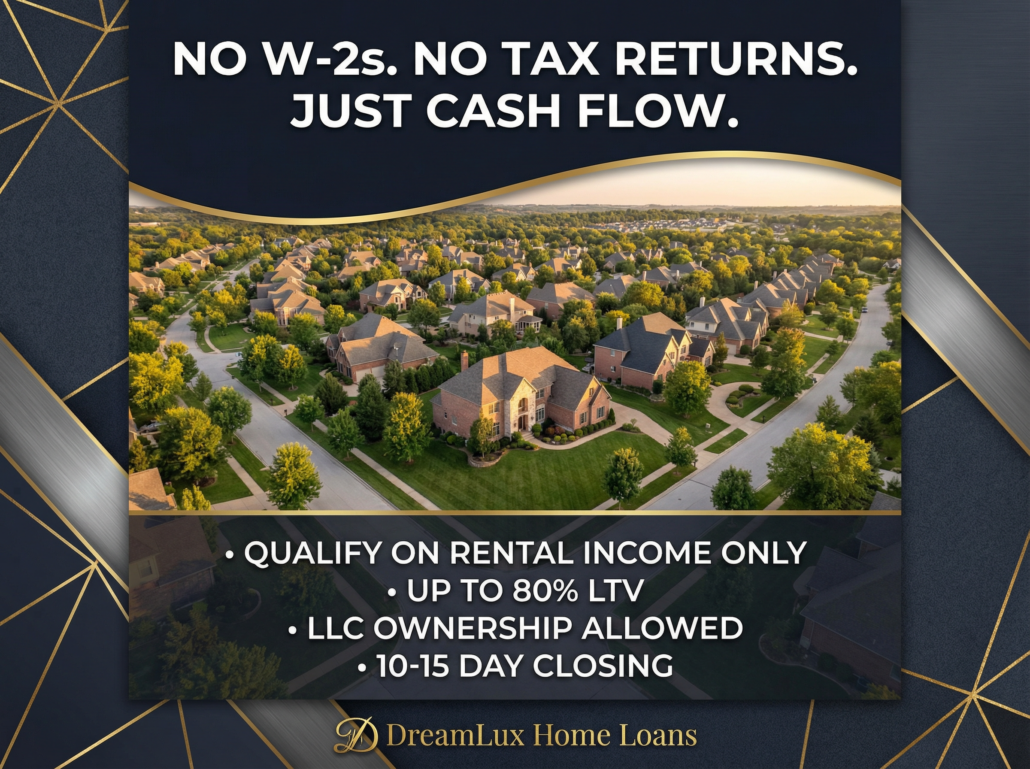
Your tax returns are lying about your wealth. If you own rental properties that generate consistent cash flow but show paper losses thanks to depreciation and cost-segregation deductions, traditional mortgage lenders will reject you. That is the frustrating reality for thousands of real estate investors across Missouri and Kansas who are cash-flow positive but document-poor on paper.
A DSCR loan changes the entire approval equation. Instead of scrutinizing your W-2s or personal tax returns, lenders evaluate whether the property itself earns enough rental income to cover its debt obligations. It is a fundamentally different underwriting logic, and for scaling investors, it is often the fastest path to acquiring the next property.
In this guide, you will learn exactly how the debt-service coverage ratio is calculated, what thresholds DreamLux Home Loans’ network of 280-plus lenders typically requires, and how Missouri and Kansas market conditions affect your strategy. You will also walk through a real worked example using a Missouri rental property, get an honest breakdown of rates and requirements, and finish with a clear framework for deciding whether a DSCR loan fits your next investment move.
What Is a DSCR Loan and How Does It Work?
A DSCR loan (Debt-Service Coverage Ratio loan) is a mortgage product designed specifically for investment properties, where the property’s rental income determines whether you qualify, not your W-2s, tax returns, or personal debt-to-income ratio. The single question a DSCR lender asks is straightforward: does this property generate enough income to cover its own debt payments?
That logic is the direct opposite of how conventional lenders operate. A traditional mortgage underwriter pulls your tax returns, verifies your employment, and calculates your personal DTI against every debt you carry. DSCR underwriters skip that file entirely. They evaluate the asset, not the applicant’s personal financial biography.
Who This Product Is Built For
Three investor profiles run into conventional lending walls repeatedly:
- Investors with paper losses. Depreciation is a non-cash tax accounting deduction reported on Schedule E. It reduces your taxable income on paper without reducing the rent check that hits your bank account. A property collecting $2,000 per month in rent can simultaneously post a tax loss, and a conventional lender reading that return will treat it as negative income, often declining the loan despite genuine positive cash flow.
- Self-employed investors. Business deductions that legitimately reduce tax liability also compress the income figure conventional underwriters use to approve loans. Actual cash flow and reported income are two different numbers.
- Multi-property portfolio builders. Each conventional investment property loan adds to personal DTI. Investors scaling past three to five properties frequently hit a ceiling where no additional conventional loan is possible, regardless of how well each individual property performs.
DSCR lending sidesteps all three barriers by anchoring the decision to the property. You can learn more about how this product is structured on DreamLux’s DSCR loan overview page.
The DSCR Formula
The Debt-Service Coverage Ratio is calculated as:
DSCR = Net Operating Income / Total Debt Service
Two components make up this equation:
- Net Operating Income (NOI): Rental income minus vacancy allowance and operating expenses. This is the cash the property actually produces after its ongoing costs are paid.
- Total Debt Service (PITIA): The full monthly cost of carrying the loan, including principal, interest, property taxes, hazard insurance, and any HOA dues. Every dollar the property owes each month lives in this number.
A DSCR above 1.0 means the property generates more income than it costs to carry. A ratio of exactly 1.0 means it breaks even. Section 2 walks through a complete Missouri rental property calculation using realistic figures so you can apply this formula to your own next acquisition.
How to Calculate Your DSCR: A Step-by-Step Walkthrough
Now that you understand the DSCR formula conceptually, here is how to run the numbers on an actual property.
Step 1: Identify Gross Monthly Rent
If the property has a signed lease in place, use that monthly rent figure. If the property is vacant or you are purchasing it without a tenant, lenders rely on a market rent opinion from a licensed appraiser, documented on a market rent appraisal (commonly Form 1007 for single-family properties, confirm with your lender). This appraisal-based figure is what the lender will use to underwrite the loan, so it carries the same weight as an executed lease.
Step 2: Apply a Vacancy and Credit Loss Allowance
Lenders do not assume 100% occupancy. Most apply a vacancy and credit loss allowance (the percentage varies by lender and market) to account for turnover and non-payment risk. Subtract this amount from gross rent to arrive at effective gross income.
Step 3: Calculate Net Operating Income
From effective gross income, subtract your operating expenses. These typically include a property management fee (confirm the local rate for your market) and maintenance reserves. Do not include your mortgage principal or interest at this stage. Those are debt service costs, not operating costs, and mixing them in will distort your NOI.
Step 4: Calculate Total Debt Service (PITIA)
Total debt service is the full monthly cost of carrying the loan. Add together:
- Principal and interest (your actual monthly mortgage payment)
- Property taxes divided by 12
- Hazard insurance divided by 12
- Any HOA or condo dues
This full PITIA figure is your denominator.
Step 5: Divide NOI by Total Debt Service
DSCR = NOI / Total Debt Service
The result is a ratio. A ratio above 1.0 means the property generates more income than it costs to carry.
Worked Missouri Example
Consider this illustrative example of a $200,000 single-family rental in Missouri. The investor puts 25% down ($50,000), financing $150,000. At current non-QM rates, that produces a principal and interest payment of roughly $1,050 per month.
| Line Item | Monthly Figure |
|---|---|
| Gross rent | $1,800 |
| Vacancy allowance (5%) | -$90 |
| Operating expenses (20% of gross) | -$360 |
| Net Operating Income | $1,350 |
| Debt Service Component | Monthly Figure |
|---|---|
| Principal and interest | $1,050 |
| Property taxes ($2,100/yr estimate) | $175 |
| Hazard insurance ($960/yr estimate) | $80 |
| Total Debt Service (PITIA) | $1,305 |
DSCR = $1,350 / $1,305 = 1.035
That 1.035 clears the minimum threshold most lenders require. It is not a home run ratio, but it is a fundable deal. To understand what typical DSCR loan requirements look like across different lenders, the thresholds section covers that in full.
How to Interpret Your Ratio
- 1.0 exactly: The property covers its own debt service with nothing left over. Some lenders approve this; others want a cushion.
- 1.25 or above: A stronger ratio signals lower risk and may unlock better pricing tiers at many lenders, confirm current thresholds with your lender.
- Below 1.0 (for example, 0.95): The property does not fully cover debt service. Some lenders in DreamLux’s network still approve sub-1.0 ratios with compensating factors such as a larger down payment or a strong credit score, minimum thresholds vary by lender and product.
A DSCR loan calculator can compress these five steps into seconds. Running the math manually first, however, shows you exactly which variable to pull: raise the rent, reduce the loan amount, or cut expenses. That clarity makes every lender conversation more productive.
DSCR Loan Requirements: What Lenders Actually Evaluate
Now that you know how to calculate your DSCR, the next question is whether that number is enough. Lenders evaluate several factors beyond the ratio itself, and understanding each one before you apply puts you in a stronger position.
DSCR Thresholds
Lenders in DreamLux’s network of 280+ lenders typically require a minimum DSCR that varies by lender and product tier, commonly starting at 1.0 for standard approvals. Sub-1.0 products do exist, but they carry compensating factor requirements, typically a larger down payment, a stronger credit profile, or both. Ratios of 1.25 and above generally unlock better rate pricing.
Credit Score Requirements
Most non-QM DSCR products set a minimum credit score that varies by lender; many non-QM DSCR products start in the 620–660 range depending on the lender. Pricing improves meaningfully at 700 and above. Some portfolio lenders will work below 620, but only when the borrower brings significant equity to the table. If your score sits near the floor, expect a higher rate, not necessarily a decline.
Down Payment Requirements
Standard DSCR products require typically at least 20 percent down, though requirements vary by lender and property type. Short-term rental properties and condotels are often higher for short-term rentals and condotels, confirm with your lender. A larger down payment does more than satisfy the LTV requirement; it can also serve as a compensating factor if your DSCR ratio is borderline.
Eligible Property Types
DSCR financing covers single-family investment properties, 2-to-4-unit multifamily, condominiums (warrantable and non-warrantable treatment varies by lender), and short-term rentals. Primary residences are not eligible. If you are investing at the Lake of the Ozarks and want to understand how lender requirements apply in that specific market, what are typical DSCR loan requirements at the Lake? covers that directly.
What Replaces the Tax Return
Instead of W-2s or tax returns, lenders request a signed lease agreement or a market rent appraisal (Form 1007 for single-family), proof of property insurance, and a title commitment. If you are borrowing through an LLC or other entity, add the entity formation documents and the operating agreement to that list.
Why Lender Access Changes the Outcome
DSCR loan requirements are not uniform. One lender may decline a 0.90 DSCR outright; another approves the same deal with 30 percent down. A single retail lender can only offer its own thresholds. Working with a broker that has access to 280+ lenders means comparing actual approvals across the market rather than accepting the first answer as final.

DSCR Loan Rates: What to Expect and What Moves Them
Once you understand what thresholds lenders require, the next natural question is what rate you will actually pay to access that flexibility.
DSCR loan rates carry a premium above comparable conventional investment property rates (the spread varies; request a live quote for your specific scenario). For investors who qualify on W-2 income and strong personal DTI, that premium deserves a hard look. For investors whose tax returns show Schedule E losses from depreciation, the comparison is not DSCR versus conventional; it is DSCR versus no loan at all. Framed that way, the premium is the cost of access, not a penalty.
What Moves Your Rate
Five variables do most of the work:
- DSCR ratio. A stronger ratio signals lower repayment risk. Lenders typically tier their pricing, and a 1.25 or higher DSCR often unlocks meaningfully better rates than a 1.0 or a sub-1.0 approval. As noted in the calculation walkthrough, a stronger ratio earns better pricing, the same principle applies to rate.
- Loan-to-value. Lower LTV reduces lender exposure. Putting 30% down instead of the 25% minimum frequently improves pricing.
- Credit score tier. Most non-QM DSCR products step pricing at key thresholds. A 740 score prices better than a 680, which prices better than a 640.
- Property type. Single-family investment properties generally receive the most favorable non-QM pricing. Two-to-four unit properties and short-term rentals carry additional risk adjustments at many lenders.
- Lender selection. Non-QM rate sheets vary significantly across lenders. This variable is often underestimated.
The Missouri vs. Kansas Rate Wrinkle
Missouri’s effective property tax rate is lower than Kansas’s on average, verify current rates with your county assessor, as this difference directly affects your PITIA and DSCR. Higher PITIA compresses the DSCR ratio, potentially pushing a deal into a higher rate tier or requiring compensating factors.
Investors comparing properties across the state line should recalculate DSCR using state-specific tax figures before assuming the Kansas deal pencils the same way. That PITIA difference is why investors should always run state-specific inputs rather than blended estimates.
Get Live Quotes Before You Commit
Actual rates change daily and vary widely across lenders. No published range substitutes for a live quote on your specific property, DSCR, LTV, and credit profile.
A single retail lender can only quote its own rate sheet. Working with DreamLux means comparing live offers across non-QM, portfolio, and agency-eligible DSCR products from 280-plus lenders in one conversation. For a loan type where lender-to-lender variation runs wide, that comparison often finds materially better pricing than any single-lender conversation would. Conventional investment property financing follows the same multi-lender logic; I Price Every Tier Before You Choose One.
Why Missouri and Kansas Are Strong Markets for DSCR Lending
Those rate differences don’t exist in a vacuum. Where you buy determines whether your DSCR math works before you ever talk to a lender, and Missouri and Kansas offer structural advantages that coastal markets don’t.
The Midwest Price-to-Rent Advantage
DSCR qualification lives or dies on the relationship between what a property rents for and what it costs to acquire. Where purchase prices are high relative to rents, debt service is high and clearing 1.0 requires exceptional rent performance. Missouri and Kansas metros consistently produce gross rent yields that make the 1.0 threshold achievable on a standard acquisition. That advantage is baked into the math.
Missouri Market Snapshot for 2026
Kansas City remains one of the more active rental markets in the region, with steady demand for single-family and small multifamily properties. Strong population retention and consistent employment keep vacancy rates manageable.
Columbia and Jefferson City offer reliable demand profiles. Columbia’s rental market is anchored by University of Missouri enrollment, creating durable demand that doesn’t closely track broader economic cycles. Jefferson City’s stability comes from state government employment, a tenant base that trends toward longer leases and lower turnover.
St. Louis presents a range of entry points. Neighborhoods outside the urban core attract investors because lower acquisition costs produce favorable rent-to-price ratios, often clearing 1.0 DSCR with room to spare.
Kansas Market Snapshot
On the Kansas side, Kansas City (KS) and its suburbs draw investors who actively compare properties across the state line. Purchase prices in many Kansas metros remain lower relative to achievable rents, producing competitive DSCR outcomes. Cross-border investment is common, and investors often hold properties in both states.
The Property Tax Variable You Cannot Ignore
Missouri’s effective property tax rate is lower than Kansas’s on average, verify current rates with your county assessor, as this difference directly affects your PITIA and DSCR. That PITIA difference is why investors should always run state-specific inputs rather than blended estimates.
Serving These Markets Directly
DreamLux Home Loans is licensed and actively works with investors across Columbia, Ashland, Jefferson City, Lake of the Ozarks, Kansas City, and St. Louis. Investors who want broader regional context before running their numbers can review buying a home in Missouri or Kansas, answered.
DSCR Loan Pros and Cons: An Honest Assessment
Understanding the Missouri and Kansas market dynamics helps investors evaluate whether a specific deal pencils out. The next step is weighing whether DSCR lending itself is the right structure for your portfolio. Here is an honest look at both sides.
The Advantages
No tax returns or W-2s required. Qualification rests entirely on the property’s income. For investors whose Schedule E shows paper losses driven by depreciation, this removes the single biggest obstacle to approval. The property’s cash flow is the application; your personal tax situation is irrelevant.
No accumulating DTI ceiling. Conventional lenders track every mortgage payment against your personal income. Add enough properties and you eventually hit a wall regardless of how well those properties perform. DSCR sidesteps that entirely. Each property qualifies on its own cash flow, so the fifth acquisition faces the same underwriting logic as the first.
LLC and entity borrowing is compatible. Many DSCR lenders allow the borrowing entity to be an LLC or similar business structure. For investors who already hold properties in an LLC for liability protection, this means financing can align with the ownership structure rather than forcing a work-around.
Simpler underwriting means faster closings. Without income verification, pay stubs, or employer calls, the underwriting process is leaner. In competitive acquisition environments where sellers favor speed, that compression is a practical advantage, not just a convenience.
The Trade-offs
Rates run higher than conventional. The rate premium discussed in the rates section is the main cost trade-off. On a 30-year loan, model the full-term cost before concluding that DSCR is always the optimal vehicle. For some deals it is the only vehicle; for others, conventional may be worth qualifying for.
More capital required upfront. Down payment requirements are higher than owner-occupant programs, DSCR is an investor product and is priced accordingly. Factor this into your capital allocation plan before committing to an acquisition pace.
The property must cash flow. This point is non-negotiable. If the rent-to-price ratio on a given property cannot generate enough income to cover debt service, no DSCR product will approve it regardless of the borrower’s net worth or credit profile. Investors targeting appreciation plays in low-yield markets will find DSCR largely unavailable for those acquisitions. The formula is unambiguous: the numbers either work or they do not.
Short-term rental income is treated inconsistently across lenders. This is the area where due diligence matters most for Airbnb and vacation rental investors. Some lenders use market income projections; others require documented operating history before counting STR income, policies vary materially across lenders. Choosing the wrong one means a denial that a different lender would have approved. Investors in Missouri’s Lake of the Ozarks vacation rental market, for example, face exactly this variance; the Common Questions from Lake of the Ozarks Homebuyers resource covers relevant considerations for that market.
The most practical takeaway: DSCR loans solve a real problem for a specific investor profile. They also carry real costs. Matching the product to the deal, and the lender to the product, is where the outcome is determined.

Is a DSCR Loan the Right Move for Your Investment Strategy?
Knowing the pros and cons puts you ahead of most investors. The next step is deciding whether DSCR fits your specific situation, because it is the right tool for some investors and the wrong one for others.
The Ideal DSCR Candidate
You are a strong fit if you check most of these boxes:
- Two or more existing rental properties already in your portfolio
- A competitive credit score (680 or above is a common pricing inflection point across many lenders, though minimums vary)
- Sufficient capital for a down payment on the target property (confirm current requirements with your lender, as minimums vary by property type)
- A target market where rent yields support a DSCR at or near 1.0, such as Kansas City, Columbia, or the St. Louis suburbs covered earlier in this guide
Investors who match this profile frequently hit a wall with conventional financing, not because their properties perform poorly, but because accumulated rental income and depreciation deductions produce a tax picture that conventional underwriting cannot parse favorably.
When Conventional Financing May Still Be the Better Call
DSCR should be compared, not assumed to be optimal. If you have straightforward W-2 income, fewer than two investment properties, and a clean personal debt-to-income ratio, a conventional investment property loan may qualify you at a lower rate. The rate premium on DSCR products is real money over a 30-year term. Run both scenarios before deciding.
When DSCR Is the Only Practical Path
For investors whose tax returns show Schedule E losses driven by depreciation or accelerated cost-segregation deductions, conventional lenders will typically decline the application regardless of actual cash flow. This is not a borderline situation that better documentation can fix. The income the property generates does not appear on paper in a form conventional underwriting accepts. DSCR is not a preference in these cases; it is the structural solution.
Complementary Programs Worth Knowing
Self-employed investors who prefer using business bank deposits rather than tax returns may benefit from bank statement loans available through DreamLux. Investors acquiring a primary residence alongside investment properties can combine programs: conventional or FHA for the primary, DSCR for the investment side. The frequently asked questions and loan program details on DreamLux’s site cover eligibility across these options.
Your Decision Prompt
Before calling a lender, run your target property through the DSCR formula from Section 2. Running your DSCR calculation before you call gives you a concrete starting point for that lender conversation.
Start With the Property, Not the Pay Stub
Once you have worked through the strategy question, the underlying principle stays constant: the property’s income either covers its debt service or it does not. DSCR lending puts the approval decision exactly where it belongs for investment property.
Before your next lender conversation, run the numbers yourself. Walking in knowing your DSCR ratio changes the conversation entirely. You are no longer guessing whether a property qualifies; you are discussing terms.
One first “no” is not a final answer. A 0.95 DSCR that one lender declines may clear approval at another lender with a lower minimum threshold or a compensating-factor provision. Underwriting standards vary meaningfully across the non-QM market, and no single lender represents the full range of available options. Working with a brokerage that has access to 280+ lenders means the search continues past the first door that closes. Missouri and Kansas investors can compare live DSCR loan rates and requirements by reaching out to DreamLux Home Loans directly through dreamluxhomeloans.com.
Missouri and Kansas investors can compare live DSCR loan rates and requirements across multiple lenders by reaching out to DreamLux Home Loans. Start your application or contact Zach Brown, Senior Mortgage Loan Officer, NMLS #2156538, directly through dreamluxhomeloans.com. NEXA Lending compliance disclosures apply.
Conclusion
DSCR loans remove the biggest obstacle most real estate investors face: proving income through tax returns that often understate their financial position. The qualifying logic is property-first, the math is calculable before you call, and 280+ lenders means one rejection is not a final answer.
The investors who scale their portfolios fastest are the ones who understand their numbers and work with lending partners who have real market access. Run your DSCR calculation today, identify your next target property, and reach out to DreamLux Home Loans to compare live rates across multiple lenders. The next deal is closer than your tax returns suggest.